Church & Ministry Leadership Insights

Curated insight for churches in seasons of growth, transition, and change.

A focused resource page from Jemico Consulting for leadership alignment, operational clarity, staffing, systems, and strategic execution in ministry environments.

Strategic Clarity.

Stronger Leadership.

Sustainable Growth.

Approved-only resources from trusted church leadership sources.

Built for a Supabase data pipeline and simple admin review.

Designed to feel like a natural extension of the Jemico website.

Focus Areaschurch_leadershipoperational_clarityleadership_alignmentguest_experiencechurch_systemschurch_growth

Featured Articles

Leadership & operations resources

Every item should remain a clearly attributed external resource. Jemico summaries help visitors decide what to read next without republishing full source content.

Your Church Is Placed Where It Is on PurposeArticle

church_leadership

Your Church Is Placed Where It Is on Purpose

by Thom S. Rainer Founder It is easy for a church to see its location as incidental. The building is where it has always been. The neighborhood has changed. The community may no longer look like it once did. Over time, the church can begin to feel out of place—almost like it is simply holding on in a setting that has moved past it. But that perspective misses something important. Your church is not where it is by accident. God, in His sovereignty, has placed that congregation in a specific location, among specific people, at a specific time. The address is not random. The neighborhood is not incidental. The community is not a coincidence.

by Thom S. RainerMay 29, 2026
Read insight
A Goodness Worth Living: God’s Vision in a Confused WorldArticle

operational_clarity

A Goodness Worth Living: God’s Vision in a Confused World

by Jacki C. King Church Answers Women Every few years a movie or cultural moment pushes us to wrestle with big ideas, questions of justice, identity, purpose, and of course, what it really means to be good. With the release of the movie, “Wicked: For Good,” conversations about goodness, darkness, and the blurry line between them are circulating again. Anytime a new buzz word and phrases start to pop up, it’s a perfect moment for Christians, especially women seeking to live faithfully in their generation, to pause and ask: Do we understand goodness the way God defines it? Because the truth is, most of us absorb our ideas of “good” without ever examining them. Culture catechizes us subtly through storylines, lyrics, and characters, often convincing us that goodness is something found within or achieved by our own efforts. Without intentionally looking to Scripture and remembering what we are actually working toward, we can easily end up pursuing the wrong thing. So what is biblical goodness? And why does it matter for the way we live, love, and serve today in our homes, workplaces, and communities? Goodness Begins in the Garden Before sin fractured the world, goodness was the natural state of everything God made. Over and over again in Genesis 1, God looks upon His creation and declares: Not just aesthetically pleasing. Not simply functional. Not good in comparison to something worse. Good because it aligned with God’s character. Good because it reflected His order, His beauty, and His intention. Goodness, in Scripture, is never self-defined. It is always God-defined because he is the ultimate source of it. When Eve reached for the forbidden fruit, Scripture says she saw that it was “good for food… and desirable.” But she defined good on her own terms rather than…

by Jacki C. KingMay 29, 2026
Read insight
The Hidden Unchurched HarvestArticle

leadership_alignment

The Hidden Unchurched Harvest

by Thom S. Rainer Founder Pastors and church leaders often focus on those who seem most spiritually receptive—the seekers, the hurting, and the curious. But in 2003, I developed what became known as the Rainer Scale, a framework that helps churches understand the varying levels of receptivity among unchurched people. Over the past two decades, as we have applied this scale in thousands of contexts, a surprising insight has emerged. The largest mission field is not the eager or the resistant. It is the neutral middle—the group we identify as the U3. These individuals are neither pursuing faith nor running from it. They are simply living life without giving church much thought. Yet despite their silence, they represent one-third of the entire unchurched population, an estimated 30 to 35 million Americans. U3s do not respond to big campaigns or aggressive strategies. But they are remarkably open when approached with relationships, consistency, and genuine care. They are, in many ways, the hidden unchurched harvest, waiting quietly on the edges of our communities. Here are some facts about the U3 that will help you understand them and reach them. They Are Not Opposed to Church — They Are Disconnected One of the most surprising realities about the U3 is how little hostility they carry toward the church. These men and women are not angry, wounded, or spiritually resistant. They are simply disconnected. Faith and church life operate somewhere in the background of their minds, not because of bitterness, but because they have slowly drifted into a life where spiritual involvement no longer feels relevant. Their neutrality is not a reaction—it is a habit. This group doesn’t stay away because they object to Christianity. Rather, church has become a non-factor in their…

by Thom S. RainerMay 29, 2026
Read insight
8 Predictors of Church Growth: Understanding the Rainer Predictive IndexArticle

guest_experience

8 Predictors of Church Growth: Understanding the Rainer Predictive Index

by Thom S. Rainer Founder We cannot predict the mysterious work of the Holy Spirit. Jesus reminded us that “the wind blows wherever it wants. Just as you can hear the wind but can’t tell where it comes from or where it is growing, so you can’t explain how people are born of the Spirit” (John 3:8, NLT). Church growth is never a formula. It is never a guarantee. It is always, at its core, the gracious movement of God. But we can learn from the patterns of how the Spirit has worked in churches across generations. We can observe the conditions that often accompany spiritual renewal and numerical growth. And we can pay attention to the practices that consistently place a church in the path of God’s activity. That is the purpose of the Rainer Predictive Index. It doesn’t replace prayer or dependence. It simply highlights the factors most strongly correlated with growing, healthy congregations. When these predictors are present, churches tend to flourish. When they are absent, churches often decline. 1. Has at Least Three Outreach Efforts a Year Growing churches do not drift into evangelism. They schedule it. They pray for it. And they engage their people in it. But an outreach effort is not simply a big event, a seasonal festival, or a service project in the community. Those activities have value, but they do not become evangelistic unless members intentionally invite and connect with potential guests. That personal invitation is the hinge on which outreach turns. When a church mobilizes its people to pray for others, invite others, and follow up with others, the results are far more consistent and far more transformative. We have seen this pattern repeatedly, especially as churches adopt The Hope Initiative. What began as a simple tool has become a mainstay in…

by Thom S. RainerMay 29, 2026
Read insight
A Christmas Devotion for Tired, Discouraged Church LeadersArticle

leadership_alignment

A Christmas Devotion for Tired, Discouraged Church Leaders

by Chuck Lawless Church Answers Consultant It has been a long time, but I think I was in seventh-grade that holiday season. That year, all I wanted for Christmas was a ten-speed bike. It seemed all my friends were getting one (at least, that’s what they told me), and I wanted one, too. A blue one with a black seat and handlebar covers. I knew exactly what I wanted. The problem was that my family couldn’t afford such a gift. Times had been difficult for us, and my parents let me know there would be no bike that year. They regretted that fact, but they didn’t want me to be disappointed on Christmas morning. I’d be lying to you if I said I went to bed that Christmas Eve with a great sense of anticipation and joy for the next day. In fact, I slept in longer that Christmas Day than I think I ever had. Why rush to the decorated family room when I knew no bike would be there in the first place? When I finally did get up that morning, I wandered sleepily into the family room, trying my best to look as excited as a selfish 12-year-old boy could look on a disappointing Christmas morning. I sat down at the base of the Christmas tree, looking around for the clothing I was sure was my gift that year. Then, my sister, who had already been up for some time, caught my attention and just stared at me for some reason. My mom did the same from another corner of the room. So did my dad. Everyone just looked at me as if something were seriously amiss – until my mom pointed my attention toward something I had simply not seen: my new bike, exactly as I had wanted, leaning against the wall of our family room. It’s hard to believe now, but I had walked right past it. I was apparently so consumed with my ongoing disappointment that I had completely missed the unexpected gift directly in…

by Chuck LawlessMay 29, 2026
Read insight
The Twelve Best Questions to Ask Before Going to a New ChurchArticle
leadership_alignment

The Twelve Best Questions to Ask Before Going to a New Church

by Sam Rainer President & Senior Consultant Let’s assume the best. Someone is deciding on a new church for all the right reasons. Maybe it’s you. Finding a new church can be both exciting and intimidating. Whether you’re moving to a new area or starting a new season of life, it’s wise to ask good questions before committing to a local congregation. The goal isn’t to “shop” for a perfect church (because none exists), but to discern where you can worship, grow, and serve faithfully. These questions aren’t about consumer preferences. They’re about discovering a healthy, biblical church. 1. What does the church believe about the Bible? A church’s view of the Bible determines everything else. Ask if the church affirms the authority, inspiration, and sufficiency of God’s Word. Leaders who trust Scripture will preach it faithfully and apply it consistently. 2. How does the church define and teach the gospel? Listen for clarity about salvation through faith in Jesus Christ alone. A healthy church consistently points people back to the grace of God rather than human effort or tradition. Does the church emphasize repentance, faith, and discipleship—or just attendance and activity? 3. What theological convictions shape this church? Every congregation has a doctrinal backbone. Find out about the core beliefs and where they allow freedom in secondary matters. Ask how theology shapes their ministries, not just what’s printed in the statement of faith. 4. What is a typical worship service like? Don’t just make conclusions about what you see online. Visit in person. Pay attention to whether the worship is focused on glorifying God or entertaining an audience. 5. How can I connect beyond Sunday morning? A church isn’t just a weekly event; it’s a family. Ask about small…

by Sam RainerMay 29, 2026
Read insight
Five Reasons Why Many Pastors Are Inadequately PaidArticle
leadership_alignment

Five Reasons Why Many Pastors Are Inadequately Paid

by Thom S. Rainer Founder Pastors enter ministry knowing it will be demanding, but few expect the financial pressure that follows them week after week. Still, it’s a reality in far too many churches. Most of the time, the issue isn’t intentional neglect. It’s a mix of assumptions, old habits, and blind spots. Many churches simply haven’t updated their thinking about what it costs for a pastor and family to live today. Rising housing costs, healthcare expenses, and basic living necessities hit pastors just like everyone else—sometimes harder. Yet many congregations don’t realize their compensation plans haven’t kept up. If churches want healthy, long-term pastoral leadership, they must understand why these gaps happen. Only then can they begin paying pastors with fairness, dignity, and the care Scripture calls us to show. 1. No One in the Church Is Paying Attention to the Pastor’s Compensation In many churches, the biggest reason a pastor is underpaid is surprisingly simple: no one is actually paying attention. Compensation just drifts from year to year with no review, no comparison, and no real conversation. It’s not that anyone is trying to ignore the pastor’s needs. It’s that no one feels responsible to look closely at them. Budgets get copied and pasted. Committees assume someone else is handling it. Leaders hesitate to bring up salary because it feels awkward or “unspiritual.” And before long, years pass without a single honest evaluation of what the pastor needs or what the church should be providing. When no one owns the process, the pastor ends up absorbing the gap—quietly, and often at great personal cost. Fair compensation rarely happens by accident. Someone must step up, ask the right questions, and make sure the church cares for its shepherd the way…

by Thom S. RainerMay 29, 2026
Read insight
20 Self-Evaluation Statements for Church Leaders at the Beginning of 2026Article
leadership_alignment

20 Self-Evaluation Statements for Church Leaders at the Beginning of 2026

by Chuck Lawless Church Answers Consultant I believe it’s always good to do self-evaluation as a leader, especially at the beginning of the year. Whatever your leadership position is, I encourage you to use these statements as part of your quiet time this week. Using the following scale in analyzing the statements below, critique your personal walk with the Lord and your leadership efforts for your church. _____ I sometimes forget that the church is God’s church rather than mine. _____ I get impatient with God; I want the church to grow now. _____ I pray so little that I’m leading the church in my own power. _____ I am growing as both a Christian and a leader. _____ I want my church to evangelize, but I’m not setting the example. _____ I would not want my church members to know the truth about my devotional life. _____ I am walking with God more closely today than I have in many years. _____ I want more human recognition for my efforts and success as a leader. _____ I don’t really love my church. _____ I fear that someone will find out about my private life. _____ I’m committed to my church, and I’m excited about the future. _____ I wish I had more real authority in my church. _____ My family might wonder if I should have a leadership position at all. _____ I have to “manufacture” joy in ministry most days. _____ I have a personal, intentional plan to continue growing as a leader this year. _____ I am humbled by the way God is blessing the church I lead. _____ In some ways, I am just coasting through ministry these days. _____ It has been a long time since I personally shared the gospel with anyone outside of my ministry responsibilities. _____ I am letting ministry wounds hinder my work. _____ I have a renewed sense of hope about my church. _____ I sometimes forget…

by Chuck LawlessMay 29, 2026
Read insight
Five Big Shifts in Worship Ministry Every Church Leader Needs to KnowArticle
leadership_alignment

Five Big Shifts in Worship Ministry Every Church Leader Needs to Know

by Sam Rainer President & Senior Consultant Changing the worship ministry in a church can be one of the most emotionally charged initiatives leaders undertake. Music touches deeply held personal preferences. Yet the worship ministry of many churches needs intentional change, not because of stylistic trends, but because of how people engage and grow. Healthy churches are navigating significant shifts that affect how they worship together. At its core, the success of worship ministry should not be measured by how people feel, but by how well it equips the congregation. Worship is not just an experience; it’s discipleship through song, Scripture, and shared praise. Understanding the shifts happening today helps church leaders make wise, forward-thinking adjustments. 1. Worship Ministries are Much Smaller Than in the Past A generation ago, the worship ministry was often the largest in the church, measured by the number of individuals participating. Large choirs, accompanied by orchestral musicians, could constitute upwards of a quarter of the overall weekly attendance. In the past, even mid-size churches had several worship programs, such as handbells, drama teams, and multiple age-segregated choirs. Today, only 37% of churches have an adult choir, and only 7% have a youth choir. Churches are streamlining multiple programs to focus on the main worship experience. But there’s also an opportunity here: bringing back strategic programs, such as a children’s choir or a School of Performing Arts, can engage musically gifted families and strengthen participation. Many communities face underfunding of the arts within their school systems. The church can fill the gap, and worship ministry programs—not just the worship experience—can once again be the draw. 2. Attendance…

by Sam RainerMay 29, 2026
Read insight
Formation Before Function: A January Inventory for LeadersArticle
leadership_alignment

Formation Before Function: A January Inventory for Leaders

by Jacki C. King Church Answers Women January has a way of pulling us forward before we’ve ever slowed down enough to look back. December seems to be one of the most packed months of the year for ministry leaders, and the temptation, with all the New Year’s resolutions, eating plans, and workout reminders, is to repeat the same steps in our spiritual lives and leadership. We open planners, cast vision, set goals, and ask what this year will require of us. That instinct isn’t wrong. But if we rush to function without first attending to formation, we often repeat patterns instead of discerning fruit, or worse, we plan an entire year without guidance and dependence on the God we serve. We plan from urgency rather than wisdom. We lead from momentum rather than spiritual and measured maturity. Scripture reminds us that Jesus first called the disciples to be with Him before sending them out (Mark 3:14). Formation always comes before function, and who we are becoming matters more in leadership than what we are accomplishing. Before asking what God is calling us to do this year, it’s worth considering who He has been shaping us to be. So instead of rushing into a fresh start, I invite you to take a sacred pause—a moment to honestly reflect on the past year with courage and trust. Take your time with the questions below. Maybe you grab your journal and work through the following questions and prompts, or you open up a brand new document on your computer and thoughtfully consider each line and response. These questions are not meant to discourage you or serve as an assessment. They are designed to reveal what God has already been shaping beneath the surface of your leadership this past year. Reflect on the past year and ask yourself: What is the most important thing I…

by Jacki C. KingMay 29, 2026
Read insight
What Types of Invitations Are Most Effective to Get People to Come to Church?Article
guest_experience

What Types of Invitations Are Most Effective to Get People to Come to Church?

by Thom S. Rainer Founder Invitations matter more than we often realize. Most people who visit a church do not come because of a clever slogan, a polished website, or even a well-timed social media post. They come because someone they know invited them. That “someone” makes all the difference. In this article, I want to look at four types of invitations—C⁰, C¹, C², and C³. The letter “C” refers to personal closeness. The number reflects the depth of relationship between the inviter and the invitee. The higher the number, the more effective the invitation. Not all invitations are equal. Some feel distant and impersonal. Others feel warm, trusted, and safe. Understanding these differences can help churches focus less on volume and more on relationships. When churches align their outreach with how people actually respond to invitations, evangelism becomes more natural—and far more fruitful. C⁰: Not a Personal Invitation C⁰ represents the least effective form of “invitation,” and in truth, it is not really an invitation at all. C⁰ has zero closeness. There is no personal relationship involved, no direct ask, and no sense of intentional connection. Most C⁰ efforts revolve around an event—a musical, a barbecue, a fall festival, a holiday program, or something similar. These events are usually marketed internally in the church and externally through social media, community calendars, email lists, or the church website. The assumption is that if the event is attractive enough, people will simply show up and then come to a church worship service. That assumption is rarely correct. Very few guests come to church through C⁰ alone. People who have no relational connection to a church seldom show up at a worship service. C⁰ events can still have a place. They can create…

by Thom S. RainerMay 29, 2026
Read insight
A Translation Guide for What Church Committees and Boards Really MeanArticle
leadership_alignment

A Translation Guide for What Church Committees and Boards Really Mean

by Thom S. Rainer Founder If you’ve been in church leadership longer than a few months, you’ve learned an important skill: translation. Not Greek or Hebrew. Committee. On the surface, the words sound spiritual, thoughtful, and collaborative. Underneath, there is often a second language being spoken—one shaped by caution, history, personalities, and the deep desire to avoid change. With a smile (and a little truth), here is a short translation guide for phrases many of us have heard more times than we can count. “Let’s put this on the agenda for next month.” Translation: “We hope you forget about this before next month arrives.” “We need to form a subcommittee.” Translation: “This idea makes us nervous, so let’s slow it down until it quietly expires.” “Let’s proceed with caution.” Translation: “This idea is going to create too much work for us.” “We need to think about the long-term.” Translation: “This is another crazy idea by the pastor, and we can outlast him.” “We don’t want to rush the Spirit.” Translation: “We are uncomfortable, and this sounds more spiritual than saying so.” “This could create division.” Translation: “Someone influential has already expressed concern.” “We’ve never done it that way before.” Translation: “And we would prefer to keep it that way until at least the Second Coming.” “Let’s pray about it.” Translation: “We are not ready to decide, and prayer feels like a safe parking place.” “This is a great idea—for another church.” Translation: “We hope you stop talking now.” “We need to be good stewards.” Translation: “We’ve got plenty of money, but we are tight as a drum.” None of these statements are inherently bad. In fact, many of them are spoken with good intentions and sincere hearts. The trouble comes when translation replaces…

by Thom S. RainerMay 29, 2026
Read insight
A Spiritual Warfare Reason that Evangelism is HardArticle
church_leadership

A Spiritual Warfare Reason that Evangelism is Hard

by Chuck Lawless Church Answers Consultant Evangelism is hard for most believers. Sometimes fear stops them from speaking the good news. Most believers have no strongly evangelistic role models. Many have never been trained in evangelism in the first place. Frankly, some Christians are also simply apathetic about the lost. In this post, though, I want to talk about another hindrance to evangelism we seldom consider: a supernatural enemy who fights against us. Think about it this way. The Bible is clear about the condition of non-believers, and its writers often speak of lostness in terms of spiritual conflict. The apostle Paul particularly uses this imagery: Ephesians 2:2 (NLT) – “You used to live in sin, just like the rest of the world, obeying the devil—the commander of the powers in the unseen world. He is the spirit at work in the hearts of those who refuse to obey God.” 2 Corinthians 4:3-4 – “If the Good News we preach is hidden behind a veil, it is hidden only from people who are perishing. Satan, who is the god of this world, has blinded the minds of those who don’t believe.” Colossians 1:13-14 – “For he has rescued us from the kingdom of darkness and transferred us into the Kingdom of his dear Son, who purchased our freedom and forgave our sins.” 2 Timothy 2:26 – “Then they will come to their senses and escape from the devil’s trap. For they have been held captive by him to do whatever he wants.” Acts 26:17b-18a – “Yes, I am sending you [the Apostle Paul] to the Gentiles to open their eyes, so they may turn from darkness to light and from the power of Satan to God.” Ephesians 2:2 (NLT) – “You used to live in sin, just like the rest of the world, obeying the devil—the commander of the powers in the unseen world. He is the spirit at work in the hearts of…

by Chuck LawlessMay 29, 2026
Read insight
Ten Nonnegotiable Rules for Student Safety in ChurchesArticle
leadership_alignment

Ten Nonnegotiable Rules for Student Safety in Churches

by Sam Rainer President & Senior Consultant Student ministry is often where rules about minors break down in the church. Student ministries don’t need fewer rules than children’s ministries. They need different rules. Though rebellion seems to be a rite of passage for many teenagers, they are far more receptive to guidance than you might think. Young people need leaders to shoot straight with them. About life. With biblical depth. We don’t need to wade in the shallows and soft peddle the Christian faith. Instead, we must shepherd our youth through the depths of Scripture and the valleys of life. Be clear and honest with them. One sure way to confuse the younger generation is to set expectations and then not hold anyone accountable. A lack of transparency from adults is frustrating to teenagers. The younger generation tends to follow leaders who are transparent rather than distant or detached. And they want to know they’re not alone in their struggles. Consider the following best practices for building better student safety systems in our churches. 1. Never alone applies to teens as well. As in children’s ministry, leaders, staff members, and volunteers should always have a third party present when meeting with a student. This rule applies to vehicle rides as well. If a situation requires one-on-one counseling, meet in a room with a camera, leave the door slightly ajar, and make sure another responsible adult is nearby. There may be times when you end up alone with a student unintentionally. For example, parents might be late picking up their teen, and you’re the only one available to stay until they arrive. In such a case, contact the parents and inform them of the situation. If the parents are unavailable, contact another church leader. 2. Report any reasonable…

by Sam RainerMay 29, 2026
Read insight
Six Reasons Churches Experience the DoldrumsArticle
guest_experience

Six Reasons Churches Experience the Doldrums

by Thom S. Rainer Founder The doldrums rarely arrive with a crash. They slip in quietly. Attendance holds. Giving is steady. Conflict is minimal. On the surface, the church looks fine. But underneath, something feels off—less joy, less urgency, less expectancy. Leaders sense it in meetings. Members feel it in worship. The church isn’t declining, but it isn’t advancing either. These seasons are confusing because they lack obvious villains. No scandal. No crisis. Just a slow loss of momentum and spark. Below are six common reasons churches find themselves in the doldrums. 1. Mission Drift Without Mission Denial Most churches in the doldrums have not rejected their mission. They still affirm it. They can recite it. It appears on the website, in printed materials, and sometimes even in sermons. On paper, the mission is intact. In practice, however, it has slowly lost its influence. Mission drift without mission denial happens when the mission no longer functions as a filter for decisions. Meetings focus on logistics, preferences, and legacy programs rather than purpose. Ministries continue because stopping them feels uncomfortable, not because they clearly advance disciple-making. Over time, energy leaks. People stay busy but grow weary. Activity increases while impact declines. This kind of drift is subtle, which makes it dangerous. Nothing feels urgent enough to change. The church is not moving backward, but it is no longer moving forward with clarity. Momentum begins to return when leaders consistently bring the mission back to the center. Not as a slogan, but as a question: Does this move us toward what God has called us to do? 2. Comfort Has Replaced Expectancy Comfort often feels like health. The church calendar is predictable. Worship services are…

by Thom S. RainerMay 29, 2026
Read insight
When “Love” Is More Than Affirmation: A Biblical Vision for Women’s DiscipleshipArticle
leadership_alignment

When “Love” Is More Than Affirmation: A Biblical Vision for Women’s Discipleship

by Jacki C. King Church Answers Women Love is one of the most commonly used words in our culture, yet one of the least defined. We use it to describe feelings, preferences, relationships, and identities. Love becomes something we claim, something we protect, or something we demand. Rarely do we pause to consider what Scripture means when it speaks of love. Women leaders in the church have a unique opportunity and responsibility at this moment. We are not just responding to cultural confusion about love; we are actively guiding women toward a better and truer understanding. Culture often teaches that love is affirmation without formation. To love someone is to approve of their choices, avoid discomfort, and center the self. Love becomes transactional. I give you affirmation, and you give me acceptance. In this framework, love is fragile. It breaks when expectations are unmet or when truth feels costly. The biblical story presents a radically different view. Scripture shows love as based on the character of God. Love is not mainly a feeling but a stance of faithfulness. God’s love reaches out to us with both truth and grace. It recognizes what is broken, calls for repentance, and heals what sin has damaged. Love is not in conflict with truth; it is shaped by it. As women who lead, we must disciple with this fuller vision in mind. That discipleship begins by helping women see that love is not limited to romance or marriage. While Scripture holds marriage in high regard as a picture of Christ and His church, it does not portray marriage as the most complete or ultimate expression of love. Jesus Himself lived a fully human life marked by deep relationships, sacrificial love, and perfect obedience to the Father, all without being married. Our churches and ministries…

by Jacki C. KingMay 29, 2026
Read insight
How Should Pastors Organize Their Libraries?Article
leadership_alignment

How Should Pastors Organize Their Libraries?

by Thom S. Rainer Founder Most pastors don’t need encouragement to buy books. They need help figuring out where to put them. That reality surfaced recently in a thoughtful thread on Church Answers Central, our membership hub (see this link to join). Pastors asked good questions. They shared real constraints. Shelves. Offices. Time. And a common challenge: How do I organize a growing library so it actually serves my ministry? I’m grateful for every comment and follow-up question in that conversation. The collective wisdom was strong. What follows, however, focuses primarily on the approach I recommended. The goal is not perfection. Start with broad categories—not too many. If your library has grown by several hundred volumes, simplicity becomes your ally. Resist the temptation to create dozens of narrow classifications. You’re not running a seminary library. You’re serving a local church. A helpful target is 8–12 major categories. That number provides enough structure to find what you need without creating unnecessary complexity. Here is a sample framework that works well for many pastors: Biblical Studies (Old Testament / New Testament) Pastoral Ministry & Leadership Culture, Ethics, and Apologetics That list may flex slightly depending on your ministry context. Some pastors add missions. Others add counseling. That’s fine. The key is restraint. Fewer categories mean less decision fatigue and faster access. Sub-organize only where volume demands it. Once your major categories are in place, pause before adding layers. Not every section needs subdivision. But when a category grows large, light structure can be helpful—as long as it remains intuitive. Here are a few examples that tend to work well: Biblical Studies Old Testament arranged by canonical…

by Thom S. RainerMay 29, 2026
Read insight
Winning Your Spouse’s Heart While Doing Your MinistryArticle
leadership_alignment

Winning Your Spouse’s Heart While Doing Your Ministry

by Chuck Lawless Church Answers Consultant I write this post with some trepidation, simply because I still have much to learn about being a good husband in ministry. Pam and I have been married for almost 35 years, and it seems I learn something new about marriage every day. Nevertheless, here are some of my thoughts on this topic (or, to put it more honestly, here are some things I’m still learning to do) as we approach Valentine’s Day: At least weekly, ask God to show you how to keep winning your spouse’s heart. If you’re anything like me, you need help meeting this goal. In fact, I’m writing this post because we at Church Answers know church leaders often need some guidance here. Who better to ask for help than the God who requires us to love our spouses with a godly, sacrificial, undying love? Seeking Him is an expression of how much we want to pursue our spouse in a way that honors Him, even as we minister to others. Meditate on God’s goodness in bringing your spouse to you. Two church secretaries (the term we used for administrative assistants back then) set Pam and me up. They were convinced we needed to meet, and they orchestrated events to make it happen. I suspect I was nervous about the whole thing back then, but I’m deeply grateful now for their interest. God was in their efforts—as I’m sure He was in your situation, too. Think about how He connected you with your spouse today, and say, “Thank You.” Pray with your spouse. I strongly suggest praying together daily, even if it’s a short prayer. There’s just something both uniquely powerful and spiritually humbling when we pray with the one we love. In essence, we are saying to God, “We need You as a couple to do all that You’ve called us to do. Help us. Guide us. Give us wisdom. Keep us united.” If you…

by Chuck LawlessMay 29, 2026
Read insight
How You Should Discard an Old, Worn-Out BibleArticle
church_leadership

How You Should Discard an Old, Worn-Out Bible

by Sam Rainer President & Senior Consultant When a Bible becomes too worn to use or damaged in some way, many people feel uneasy about simply tossing it in the trash. That instinct is understandable. I’ve got a shelf full of old Bibles that I can’t seem to discard. They’re too tattered to give away but too meaningful to throw away. We know the proper etiquette of disposing of an American flag. But how should Christians discard old Bibles when it’s time? While no official rules exist, there are several respectful options. One of the oldest ways God’s people have handled sacred texts is burial. In Jewish tradition, when scrolls of Scripture wore out, they were stored in a genizah (a repository) and eventually buried in a cemetery. The idea was simple: what once carried God’s Word should be laid to rest with dignity. Christians can follow a similar pattern: Wrap the Bible in a simple cloth or paper. Say a brief prayer of thanks to God for how he has used this Bible in your life and church. Bury it in a meaningful place, perhaps on church property (with permission), in a garden, or in a family plot area if appropriate. Wrap the Bible in a simple cloth or paper. Say a brief prayer of thanks to God for how he has used this Bible in your life and church. Bury it in a meaningful place, perhaps on church property (with permission), in a garden, or in a family plot area if appropriate. Burial is a good option for Bibles that carry deep sentimental value, such as a family Bible that is literally falling apart. While I don’t think you will bring about God’s judgment for tossing a Bible in the trash with your breakfast plate scrapings, a reverent burial is a better option. Burning books is often associated with aggression or censorship, so some Christians hesitate to use…

by Sam RainerMay 29, 2026
Read insight
The Challenge of Cultural Attrition in Your ChurchArticle
leadership_alignment

The Challenge of Cultural Attrition in Your Church

by Matt McCraw Church Answers Consultant and Coach What comes to mind when you think of attrition in your church? Perhaps you think about the attrition of membership or attendance. Maybe you think about financial attrition. However, I want to draw your attention to a different and often overlooked category: cultural attrition. Attrition refers to the gradual decrease of something over time. What was once a standard or norm can slowly erode. I was recently taught by one of our faithful church volunteers how cultural attrition can take place in churches. Cultural attrition is the erosion of healthy norms that once defined the church but are lost over time. Why does culture matter so much? Culture matters because it influences everything about your church. In short, culture is “who you are and how you do things” as a church. If your identity (who you are) or your behavior (how you do things) becomes unhealthy through attrition, you have a serious problem. Culture affects how people serve, how leaders lead, how conflicts are handled, and so much more. When culture slips, the health of your church slips with it. Bob is a faithful member of the church where I serve as pastor. He ministers in our church in numerous ways, primarily helping with the upkeep of our facilities. For many years, Bob served in the U.S. Army National Guard, finishing his career as a Command Sergeant Major. Bob told me about a time when his battalion failed an artillery test. As he evaluated what went wrong, he realized that portions of the training standard may have been lost from one link in the chain of command to the next. Significant attrition had occurred. So, Bob came up with a brilliant solution: bring in the old guys. He brought in former instructors who had excelled in the past.…

by Matt McCrawMay 29, 2026
Read insight
The Growing “Age-in-Place” Ministry for ChurchesArticle
leadership_alignment

The Growing “Age-in-Place” Ministry for Churches

by Thom S. Rainer Founder A quiet shift is taking place among senior adults. Instead of moving into retirement communities or assisted living facilities, more are choosing to remain in their own homes as long as possible. The common phrase is “aging in place,” but for churches, “ministering-in-place” may be a better description. It’s not just about where seniors live. It’s about how they live—and how the church walks with them. This shift matters. A lot. Age-in-place is becoming the preferred choice, not the exception. Most senior adults want to stay where they are. Home is familiar. It’s comfortable. It holds decades of memories. For churches, this reality changes the ministry map. Senior adults are no longer centralized in one location. They are spread throughout the community—often within minutes of the church building. That means ministry must move outward. The mission field is down the street. Churches can meet practical needs—and make homes safer at modest cost. Most homes were not designed for aging bodies. Poor lighting. Slippery floors. Stairs without rails. Bathrooms without support. Small issues quietly become big risks. Here’s the good news: many fixes are simple and affordable. Extra handrails. Grab bars. Floor or motion-sensor lights. Non-slip surfaces. Clear walking paths. These changes can often be made at modest costs, yet they dramatically improve safety and confidence. Churches are uniquely positioned to help. With volunteers, coordination, and a little planning, congregations can organize home safety days, light repair teams, or simple assessments. No medical training required. Just willing hands and caring hearts. This is ministry at its most tangible. Age-in-place ministry keeps seniors engaged as disciples, not sidelined…

by Thom S. RainerMay 29, 2026
Read insight
The “Safest” Jobs in an AI World (Some Are in Christian Ministry)Article
leadership_alignment

The “Safest” Jobs in an AI World (Some Are in Christian Ministry)

by Thom S. Rainer Founder Artificial intelligence is advancing faster than most of us imagined. And whenever something moves this quickly, fear follows closely behind. Pastors ask me privately, “Is AI going to replace ministry?” Business leaders ask, “Is my job safe?” Students ask, “What should I even train for?” Let me begin with clarity. It is impossible to create a precise list of “AI-proof” jobs. Technology evolves. Tools improve. Boundaries shift. What seems safe today may look different in ten years. But we can identify patterns. We can observe which types of roles are most resistant to automation. And we can especially ask what this means for churches and Christian ministry. Below are positions frequently mentioned as the most “AI-safe.” I’ve ranked them from most resistant to least resistant — though all twenty remain highly resilient compared to information-heavy, repetitive roles. The ranking is not scientific. It is directional. 1. Caregiver (Elder Care / Special Needs Care) Hands-on physical care in unpredictable home environments. Emotional reassurance. Daily human presence. Robotics will assist. But replacing embodied compassion is another matter entirely. As our population ages, this role may grow, not shrink. End-of-life ministry is sacred territory. Presence. Silence. Prayer. Spiritual assurance. AI can offer information about grief. It cannot sit beside a dying saint and speak with eternal weight. 3. Firefighter / First Responder Burning buildings are not clean laboratories. Car accidents are not spreadsheets. These roles demand physical courage, rapid judgment, and moral responsibility. Machines may assist. Humans will lead. Extreme emotional intelligence in volatile settings. This work is relational, psychological, and morally…

by Thom S. RainerMay 29, 2026
Read insight
What Three Godly Heroes Are Teaching My Seminary StudentsArticle
leadership_alignment

What Three Godly Heroes Are Teaching My Seminary Students

by Chuck Lawless Church Answers Consultant I have five Christian “heroes” in my life—two who are now with the Lord, and the others who are 95, 82, and 77, respectively. Over the past several years, I’ve asked my three living heroes to speak to one of my graduate-level classes at Southeastern Seminary, where I teach. They join us via Zoom or Teams (sometimes with help from others on their end), but they spend significant time with my students. I know these men well, and I know how much they mean to me. But I’m always surprised by just how much my young students devour everything they say. I usually give my heroes a general topic (e.g., “Talk to us about finishing well”), but my students often want to know about even more. They ask about, for example: How did you know God’s call on your life? How did you balance raising a family with doing ministry? How did you know when it was time to make a change in ministry? What would you say to your young self if you were beginning ministry again? What’s been your “secret” to finishing well? How did you know God’s call on your life? How did you balance raising a family with doing ministry? How did you know when it was time to make a change in ministry? What would you say to your young self if you were beginning ministry again? What’s been your “secret” to finishing well? What’s caught my attention more than anything as my students converse with these godly men is this reality: my young students desperately want to hang out with and learn from older men of God who are willing to give them time. Here are some general thoughts on my mind today: 1. Most of my young students—all of whom are preparing for some kind of ministry—don’t have many genuine role models. I wish I could say they all find their spiritual heroes in their…

by Chuck LawlessMay 29, 2026
Read insight
Ministering in Grief: Presence, Perspective, and What Not to DoArticle
leadership_alignment

Ministering in Grief: Presence, Perspective, and What Not to Do

by Jacki C. King Church Answers Women Ministry provides us with a front-row seat to the full range of human experience. One week, you are standing in a sanctuary decorated with flowers, watching a young couple promise forever. The next week, you are in a hospital room where machines hum louder than the conversation. On any given day, you can find yourself at the hospital celebrating a young couple’s first baby being born, feeling the fear and excitement of the days ahead. And in the next moment, you’re standing at a graveside, trying to find words that don’t feel as thin as paper as a family questions how they will even make it through their next moments. If you stay in leadership long enough, you will walk with people through some of their highest moments and memories—engagements, marriages, new babies, graduations, job promotions—and through some of their darkest nightmares: terminal diagnoses, sudden loss, addiction, betrayal, and divorce. Ministry is tilled through different seasons, and grief is one of those seasons we do not talk about enough. I recently lost a close friend to cancer. She was only 32, and during my own questions and wonderings, it reminded me that we live in a culture that avoids death. We try to run from it with all the modern technologies and efforts at our fingertips. We sanitize it and whisper about it. We treat it as if it is an interruption to “real life,” rather than part of the natural cycle that takes hold of all of us. But Scripture does not avoid it. The apostles wrote about death with startling clarity. They called it an enemy, yes, but a defeated one. They spoke of groaning, longing, waiting, and resurrection hope. A theology of dying is not morbid. It is deeply Christian. Grief is part of our embodied existence in a broken…

by Jacki C. KingMay 29, 2026
Read insight
God’s Mission Has a Zip Code: Tangible Ways Your Church Can Love the People Next DoorArticle
church_leadership

God’s Mission Has a Zip Code: Tangible Ways Your Church Can Love the People Next Door

by Sam Rainer President & Senior Consultant God has a purpose for you: to love your neighbors and reflect Christ to them. Yes, even the odd ones. I’ll never forget the first time my wife and I spotted “bathrobe guy.” That’s what we called him, at least until we learned his real name. From the hill where our house sat, we had a perfect view into several nearby yards, including his. Nearly every day, we’d watch him in his backyard, robed and barefoot, gathering sticks from the neighborhood and performing what could only be described as a kind of interpretive dance around a small fire. My wife and I were fascinated. Then came the moment of conviction. “We should go meet him,” she said. “What? And lose our daily entertainment?” I protested half-jokingly, fully convicted. The next day, she baked cookies and walked over. I waited like a kid waiting for a report from a spy mission. “His name is Ernie,” she replied. “And he’s actually really nice.” “Did you ask about the robe… and the dancing?” “Nope. But I did invite him to church.” I’ll admit, part of me hoped he’d show up in the robe and start dancing during the worship songs. But that moment taught me something: you can’t mock your neighbors and love them like Jesus at the same time. A healthy spiritual life includes a heart for the people right outside your front door. If we don’t share Christ’s love out there, we won’t grow much in here. God’s mission sends us to the nations, but it also sends us across the street. For some, getting on a plane is a bold move. For others, it’s stepping across the lawn and saying hello to a neighbor who seems… different. But everyone needs the gospel, even those who dance in bathrobes. As Paul wrote, “Christ’s love controls us” (2 Corinthians 5:14, NLT). Your home, your job, your…

by Sam RainerMay 29, 2026
Read insight
Five Hidden Costs of Digital Convenience in the Local ChurchArticle
church_systems

Five Hidden Costs of Digital Convenience in the Local Church

by Thom S. Rainer Founder We live in the most convenient culture in history. Groceries arrive at our door. Movies stream instantly. Meetings happen without leaving home. Nearly everything can be accessed with a click. It is no surprise that the local church has followed suit. Livestreams, sermon archives, online giving, digital Bible studies—all of these can serve people well. I am grateful for the technology that allows us to extend ministry beyond our walls. But here is the concern: convenience is a helpful tool. It is a dangerous foundation. When convenience becomes central, something subtle begins to shift in the culture of a church. Let me share five hidden costs I am seeing. 1. Convenience Lowers the Bar of Commitment Digital access makes church easier to attend. But easy is not the same as formative. When worship is something we can consume anytime, anywhere, the psychological shift is significant. Gathering becomes optional. Participation becomes selective. Commitment becomes negotiable. I am not suggesting that online access is wrong. For the sick, the homebound, the traveling member—it is a gift. But if convenience becomes the norm rather than the supplement, the cost of discipleship quietly drops. And when the cost drops, depth often follows. Church was never meant to be frictionless. 2. Convenience Reduces the Power of Presence The Christian faith is incarnational. Jesus did not send a message from a distance. He came near. He walked with people. He touched lepers. He ate with sinners. There is power in presence. When believers gather physically, something happens that cannot be digitized. There are hallway conversations that lead to repentance. There are unplanned prayers at the altar. There is shared laughter. Shared tears. Screens can…

by Thom S. RainerMay 29, 2026
Read insight
Five Leadership Decisions That Quietly Kill Church MomentumArticle
guest_experience

Five Leadership Decisions That Quietly Kill Church Momentum

by Thom S. Rainer Founder Most pastors do not wake up in the morning intending to stall their church’s momentum. They pray. They prepare. They care deeply. And yet, I have watched strong leaders unintentionally slow the very work they long to see flourish. Momentum in a church is fragile. It builds slowly, but it can dissipate quickly. Often, the loss is not dramatic. It is quiet. Subtle. Incremental. Here are five leadership decisions that can quietly kill church momentum. 1. Protecting Sacred Cows Without Saying It Few leaders openly defend traditions that no longer bear fruit. Instead, they “table” conversations. They delay decisions. They soften recommendations. They avoid stepping on toes. Over time, everyone knows what is happening. The church learns that certain programs, schedules, or preferences are untouchable. Innovation slows. Younger leaders disengage. Energy shifts from mission to maintenance. You do not have to eliminate every tradition. But when mission consistently yields to nostalgia, momentum suffers. Healthy churches honor their past. They do not live in it. 2. Confusing Busyness with Fruitfulness Activity can feel like progress. Meetings are full. The calendar is crowded. Volunteers are tired. But busyness is not the same as effectiveness. Some churches are incredibly active and quietly plateaued. They are running hard—but not necessarily moving forward. Momentum grows when leaders evaluate fruit, not just effort. Are disciples being made? Are guests becoming members? Are members becoming ministers? If we reward activity without examining outcomes, we unintentionally institutionalize inefficiency. And momentum fades under the weight of unnecessary complexity. 3. Refusing to Measure What Matters Some leaders resist measurement…

by Thom S. RainerMay 29, 2026
Read insight
I Was 20, Unready, and Called to Pastor—What That First Church Gave Me Still MattersArticle
leadership_alignment

I Was 20, Unready, and Called to Pastor—What That First Church Gave Me Still Matters

by Chuck Lawless Church Answers Consultant It was March 1981. I had turned 20 just a few months before, and I was in conversation with a small country church in Ohio about becoming their pastor. Looking back now, 45 years later, the whole story is a bit unusual. I knew the church because one of their previous pastors had been the youth pastor where I was a member as a teenager. God saved me when I was 13, and the church had a few youth pastors during my teen years—but this pastor really challenged me to consider my calling to preach. When he himself became the senior pastor of the church I would later pastor, he invited me often to preach so I could grow in this task. He opened the door for me to do what I still love to do so much today: to preach the Word. I have no idea why that church called me as pastor, except that they were looking for someone who would come cheaply. And I would have preached for nothing! The crowd was small (only 19 people attended on the first Sunday), but those few made a difference in my life. Here are some things I remember: They invited me into their lives. Because I was so young, I wasn’t sure how pastors were supposed to act with members. I’m sure I was sometimes isolated and introverted, but these folks welcomed me into their homes. From the grandmother who invited me to breakfast with her family every Friday morning to the folks who allowed me to live in their home, they loved me. I was not only their pastor; I was their friend. They loved me enough to let me make mistakes… and start again. I’m honestly surprised they didn’t fire me at times because of my poor leadership. I was arrogant about my “success” as a young preacher and thought I was almost always right. I wasn’t, and they knew that fact. Still, they loved me. They gave me…

by Chuck LawlessMay 29, 2026
Read insight
Easter Services: Big Special Production or Just Like Any Other Sunday?Article
guest_experience

Easter Services: Big Special Production or Just Like Any Other Sunday?

by Sam Rainer President & Senior Consultant Planning for Easter Sunday raises a strategic question: should this service look and feel bigger and more energetic, or should it resemble the regular rhythm of worship? Both approaches have advantages and downsides. Because Easter is often the highest-attended Sunday of the year, how leaders answer this question shapes not only the experience of that day, but also what first-time and returning guests assume about the life of the church. The Special Production Strategy A “special” Easter service is one with elements not typical for the church: expanded music, dramatic productions, or large-scale creative visuals. First, this strategy signals how Easter is set apart. The resurrection of Jesus is the central event of the Christian faith, and a service that feels elevated can help communicate its significance. Intentional creativity, with more energy than usual, can stir worshipers’ emotions as they celebrate the resurrection of Jesus. For people who attend church only occasionally, the sense of “this is a big moment” can make the gospel story feel weighty and memorable. Second, a distinctive service can capture attention in a crowded cultural landscape. Many people arrive on Easter with expectations of something special. When the church meets those expectations with high-quality execution, it can lower resistance and increase receptivity. A powerful choir production or a carefully crafted visual presentation can help people who are not yet believers feel the magnitude of the resurrection. However, there are drawbacks. A service that looks nothing like the rest of the year can unintentionally mislead guests. If the music style, production, or tone is dramatically different, newcomers may assume that what they experienced is…

by Sam RainerMay 29, 2026
Read insight
The Pace of Leadership: Why Burnout Is Not a Badge of FaithfulnessArticle
leadership_alignment

The Pace of Leadership: Why Burnout Is Not a Badge of Faithfulness

by Jacki C. King Church Answers Women I was talking to another ministry leader about rhythms and leadership. She was really tired, questioning her calling, and feeling like she wanted to quit. At one point, she said something that stuck with me. She said she does not pace herself well. She just keeps going, says yes to new needs and opportunities, shows up, carries more, and pushes through until she is completely exhausted. I have felt the same way in past seasons of leadership, and maybe you have too. I think many women in ministry know this feeling. There is pressure that comes with leadership. The needs are real, and the opportunities are always present. There’s always another event, conversation, or person who needs help. Over time, it can feel like saying yes to everything is part of remaining faithful. Leading without balance will eventually lead to exhaustion instead of productivity. Sometimes the best thing to do is to pause and reflect on why we’re moving at the current pace in ministry. Before discussing rhythms, boundaries, or rest, it can be helpful to ask ourselves a few questions: What need am I trying to fulfill on my own without Jesus? What makes it hard for me to say no? What am I trying to prove to myself or others? What relationships or priorities are being neglected because of ministry? Am I leading because I am connected to Christ or because of pressure and expectation? What need am I trying to fulfill on my own without Jesus? What makes it hard for me to say no? What am I trying to prove to myself or others? What relationships or priorities are being neglected because of ministry? Am I leading because I am connected to Christ or because of pressure and expectation? These questions are not intended to make us feel guilty, but to raise…

by Jacki C. KingMay 29, 2026
Read insight
Seven Good but Uncommon Biblical Names for Boys and GirlsArticle
leadership_alignment

Seven Good but Uncommon Biblical Names for Boys and Girls

by Thom S. Rainer Founder One of the churches I served as pastor had many babies born to our church members each year. On occasion, one or both of the parents would ask me what I thought about a specific name, particularly a name in the Bible. I did not have all the tools and technology we have today, so I did my best to research the names they were considering. Today, we can go to the Social Security database and get the names given to babies each year. I did just that and, with the help of technology, found the names that have a biblical origin. My criterial were simple. The name had to be a biblical name, and it had to fall out of the top 500 rankings for the past five years. Here are the girls’ names: Rank: Outside top 1,000 Meaning: “Cassia” (fragrant spice; beauty, restoration) Scripture: Job 42:14 Meaning: “Cassia” (fragrant spice; beauty, restoration) Rank: Outside top 1,000 Meaning: “Delight, pleasantness” Scripture: Song of Songs 6:4 Meaning: “Delight, pleasantness” Scripture: Song of Songs 6:4 Rank: Outside top 1,000 (U.S. girls) Meaning: “Movement, motion” Scripture: Numbers 27:1 Rank: Outside top 1,000 (U.S. girls) Meaning: “Movement, motion” Rank: Outside top 1,000 Meaning: “Adornment, beauty” Scripture: Genesis 4:19 Meaning: “Adornment, beauty” Rank: Outside top 1,000 Meaning: “Beautiful, fair” Scripture: Exodus 1:15 Meaning: “Beautiful, fair” Rank: Outside top 1,000 Meaning: “Myrtle tree” (peace, blessing) Scripture: Esther 2:7 Meaning: “Myrtle tree” (peace, blessing) Rank: Outside top 1,000 Meaning: Often understood as “fruitful” or “increasing” Scripture: Philemon 1:2 Meaning: Often understood as “fruitful” or “increasing” And here are the rankings for the boys’ names: Rank: Outside top 1,000 Meaning: “Strength” or “swiftness”…

by Thom S. RainerMay 29, 2026
Read insight
The Silent Shift: Why Your Core Members Are Attending Less (and Telling You Nothing)Article
leadership_alignment

The Silent Shift: Why Your Core Members Are Attending Less (and Telling You Nothing)

by Thom S. Rainer Founder They didn’t leave the church. At least, not officially. They’re still on the roll. Still give occasionally. Still speak kindly when you see them. But they’re not there like they used to be. A faithful couple. Long-time members. Once present every week. Now… every now and then. No conflict. No complaint. Just fewer Sundays. This is the shift many pastors are sensing but struggling to name. It’s not loud. It doesn’t demand attention. But it is quietly reshaping the church. The Drift Is Subtle Before It Is Significant It rarely begins with a decision. It begins with a pattern. One missed Sunday becomes two. Twice a month becomes once. Then occasional becomes normal. There’s no announcement. No moment where someone says, “We’ve decided to disengage.” It just… happens. And because it’s gradual, it’s easy to overlook. After all, they’re still around. They haven’t left. But over time, the cumulative effect is significant. A once-faithful member becomes a sporadic attendee. A core family becomes a fringe presence. If you only measure loss by membership rolls, you’ll miss what’s happening in real time. They Are Not Angry—They Are Reprioritizing Here’s what makes this shift so difficult to address: They still love their church. They appreciate you as their pastor. They would even say they are committed. But somewhere along the way, church became one of several options instead of the priority. Weekends filled up. Travel increased. Kids’ activities expanded. Rest became more necessary. And without ever saying it out loud, they began to make new choices. They are not reacting—they are reallocating. You’re not dealing with resistance. You’re dealing with competition—for time, attention, and energy. The New Definition of “Regular” Has…

by Thom S. RainerMay 29, 2026
Read insight
How Church Leaders Can Combat Cultural AttritionArticle
leadership_alignment

How Church Leaders Can Combat Cultural Attrition

by Matt McCraw Church Answers Consultant and Coach My last article explored the reality of cultural attrition in the church. It is a genuine problem, and real problems call for intentional solutions. So, how do we prevent cultural attrition in our churches? Here are eleven ways to fight cultural attrition in your church. Many established churches concentrate too much on history. In fact, some church members focus so heavily on “the way things used to be” that it borders on idolatry. However, history can also serve a healthy and helpful purpose. Wise church leaders will leverage the power of history to strengthen a healthy church culture. Celebrate moments when the church worked together. Highlight seasons of generosity. Remind your congregation of its strong history of outreach and evangelism. While some parts of your church’s past may be challenging, do not discard it entirely. Celebrate what is good, faithful, and healthy from your history. 2. Commit to improvement. Your church culture can become unhealthy gradually; it can simply develop over time. However, if your culture is going to improve, it must be intentional. You need to commit to making progress. God has not called you to be a complacent leader. He has called you to continuous growth. Likewise, He has called you to lead others toward growth. To combat cultural attrition, you must commit to a purposeful pursuit of greater health as a church. God’s people have always been shaped by stories of what God has done. The same should be true in your church. Share stories of how God is working through your congregation, and intentionally link those stories to your church culture. Share testimonies from new members who joined because the church was welcoming and loving. Highlight how a local school was blessed…

by Matt McCrawMay 29, 2026
Read insight
Helping “Puzzle Piece” Christians Grow in Their FaithArticle
leadership_alignment

Helping “Puzzle Piece” Christians Grow in Their Faith

by Chuck Lawless Church Answers Consultant I followed Christ at age 13 after having heard the gospel from a seventh-grade classmate for more than a year. I did not own a Bible, and the day I got saved was the first time I had ever been inside a church building. I knew about Christianity and church only what I needed to know: God loved me, and I needed salvation. That day, God made me His child as I prayed with my pastor at the end of the worship service. To my surprise, a lady in the congregation—a lady I had never met—immediately greeted me and invited me to Sunday school the next week. That next Sunday, I was there. In fact, I was at church almost every time the doors were open. Sunday morning Sunday school, followed by the morning service. Sunday night discipleship training, then the Sunday night service. Wednesday night Bible study and prayer meeting. Thursday night outreach (we called it “visitation”). Other special events throughout the year. I never missed going to church unless my family had a prior commitment or I was sick. Every activity was an opportunity for me to learn something as a new believer, and I devoured whatever I could get. Looking back, it’s amazing how much l learned in my first years as a believer. Here was the problem, though: I learned content by sitting through sermons and classes, but I didn’t learn how to put all the content together well. More specifically, I had little idea how to absorb the content, apply it to my young life, and consequently walk more faithfully with Jesus. I was getting content but still living inconsistently—a baby in Christ whose head was filling with information, but whose feet weren’t moving quickly enough toward obedience. I was getting the puzzle pieces, but I didn’t know how to put the puzzle together.…

by Chuck LawlessMay 29, 2026
Read insight
Why Some Established Churches Die Painfully Slow DeathsArticle
church_growth

Why Some Established Churches Die Painfully Slow Deaths

by Sam Rainer President & Senior Consultant About 80% of churches are either declining or plateaued. We should celebrate the 20% that are growing, but this post is about the larger group. Struggling established churches are notorious for hanging on—not for years, but for decades. How is it that some churches can remain on life support for so long? The reasons are varied and, to some degree, contextual, but one demographic factor stands out. Most established churches naturally settle into a mode of demographic replacement. Assuming a church does not experience a mass exodus or a split, and assuming it roughly reflects the age demographics of the surrounding population (many do), the “replacement rate” of the population will kick in and keep the church afloat for decades. The average death rate in the United States is 9.2 deaths per 1,000 people—roughly 1%. You’ll lose about 1% of your congregation to death every year (a morbid thought, but also reality). The “replacement rate” of a population is 2.1 births per woman. We’re currently at 1.6 in the United States. Aside from immigration, the nation is losing population and becoming older. The same goes for churches. Fertility reductions typically begin affecting population structure within 20–30 years and produce large, system-level changes within 40–60 years. Therefore, churches—like the rest of the nation—age slowly over decades and thus take quite some time to die. The current median age of a churchgoer is about 60 years old, while the median age in the United States is 39. Churches are typically a generation older than their surrounding communities. The slow trend of aging is beginning to accelerate. Churches are not getting any younger, and it’s catching up to them. As Ryan Burge has revealed, this slow aging…

by Sam RainerMay 29, 2026
Read insight
I Blame an Elderly Woman Named Margaret for EverythingArticle
guest_experience

I Blame an Elderly Woman Named Margaret for Everything

by Sam Rainer President & Senior Consultant I blame Margaret for everything. One Sunday stands out. Our student ministry brought in a guest worship leader. The volume was too loud, and the music selection was too metal. Margaret was in the back watching. She saw me approaching the sound booth and grabbed my arm, staring intently at me. She knew exactly what I was about to do. “Margaret, you’ve got to let me go so I can tell them to turn it down.” “You will do no such thing, pastor.” “No, Samuel Solomon,” using my first and middle name for emphasis, “They are worshiping.” She was in her early 80s at the time. I blame Margaret for the growth of our student ministry. A few years later, she decided to serve on a mission trip. Some of our leaders tried to convince her not to go because the trip was challenging and would take place in a country with limited medical facilities. Given her age and health struggles, everyone knew the trip would be demanding. I’ll never forget her response, “The one ministry I’ve never done in the church is to go internationally. I cannot stand before Jesus without sharing His name cross-culturally.” Some men in our church devised a plan to go with her and stand by her side for every step of the trip. Her presence meant even more people went on the trip. I blame Margaret for the strong health of our mission efforts. She learned about our ministry to serve the homeless, and she was there every Saturday, feeding and clothing people in need. “Is there ever a day when you’re not doing something with our church?” I asked jokingly. “The day I stop serving is the day I die,” she replied in all seriousness. People of all socioeconomic backgrounds are welcome in our church. I blame Margaret. One Sunday, she brought her family’s old ration…

by Sam RainerMay 29, 2026
Read insight
Why First-Time Guests Don’t Return—Even When They Say They WillArticle
guest_experience

Why First-Time Guests Don’t Return—Even When They Say They Will

by Thom S. Rainer Founder They meant it when they said it. They smiled. They thanked you. They spoke kindly about the service. Nothing felt forced. And yet… they didn’t return. Most pastors have lived this moment more times than they can count. The experience was positive. The interaction was warm. The intention seemed real. But something happened between Sunday and the next opportunity to attend.

by Thom S. RainerMay 29, 2026
Read insight
Project Hail Mary and the Human Longing We Can’t Scroll AwayArticle
leadership_alignment

Project Hail Mary and the Human Longing We Can’t Scroll Away

by Jacki C. King Church Answers Women I am not much of a movie watcher. My mind is usually thinking about what needs to get done next. I would often rather be outside doing something active, and there is still a frugal part of me that remembers when a movie ticket cost less than eight dollars. But in the spirit of a fun family night, after hearing the steady buzz from my Gen Z students about how amazing the new “Project Hail Mary” movie was, and watching it continue to dominate the box office week after week, I decided to go. What stayed with me was not just the science, suspense, or survival. It was the reminder beneath the story. Beneath the space mission and the unknowns lies something deeply human: we were made for relationship, connection, and purpose. That truth matters for those of us serving women in the church. We spend so much time thinking about programming, calendars, volunteer schedules, communication plans, curriculum, and the endless details of ministry leadership. Those things matter. They help create environments where people can grow. But in the busyness of leading, we can sometimes forget the deeper questions every woman is carrying into our ministries. Is there purpose in my life? Will anyone walk with me through what I am facing? These are not small questions. They are worldview questions at the heart of every person, often lying quietly beneath…

by Jacki C. KingMay 29, 2026
Read insight
I’m Missing Hymns TodayArticle
church_leadership

I’m Missing Hymns Today

by Chuck Lawless Church Answers Consultant I admit it. I am reminiscing as I write this post. I realize I’m thinking back several decades, and I’m sure some of my readers might find the title of this post strangely irrelevant—but I challenge you to read on if you’re one of those readers. Differing events of life have recently reminded me of worship services of days long gone—of my first days as a believer when we sang hymn after hymn each Sunday. I knew nothing else, and hymns were the only thing our church ever sang. To be clear, I’m not saying that I miss hymns done poorly . . . bad musical accompaniment supporting words that believers sang weakly . . . or sang so slowly that it seemed you could take a nap between choruses. . . . or that we sang with the pall of a funeral home organ behind them. Those things I don’t miss. Nor am I suggesting that I don’t like the newer versions of hymns sung in a more contemporary way. I really do like this option, and I’m grateful every time my church sings hymns this way. There are ways to get even younger generations to love the hymns.

by Chuck LawlessMay 29, 2026
Read insight
New Numbers on the Southern Baptist Convention: Remarkable Recovery or Dead Cat Bounce?Article
leadership_alignment

New Numbers on the Southern Baptist Convention: Remarkable Recovery or Dead Cat Bounce?

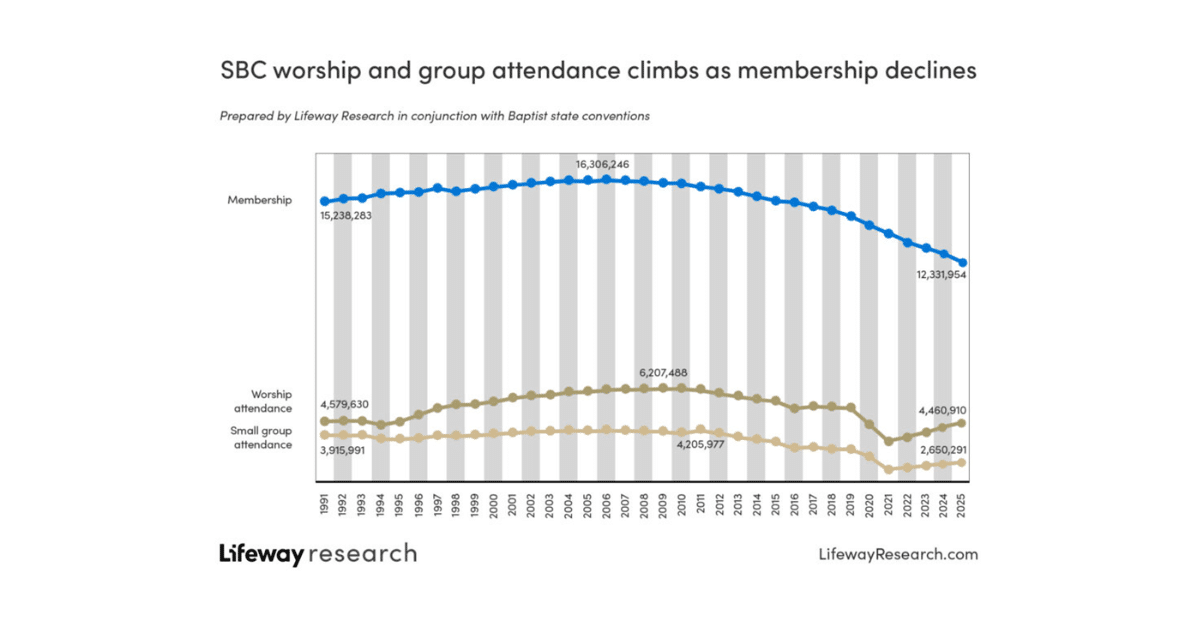
by Sam Rainer President & Senior Consultant Denominations do not exist apart from their churches. They reflect the health of the congregations within them. When more churches are healthy than unhealthy, the denomination tends to have strategic capacity. When more churches are unhealthy than healthy, denominational leaders are pushed into triage mode rather than long-term leadership. That dynamic is increasingly evident in the Southern Baptist Convention (SBC). The denomination’s challenges are not merely institutional. They are congregational. When churches thrive, denominational structures have something to amplify. When churches decline, the institutions that depend on them begin to wobble as well. I’ve always heard “the local church is the headquarters of the SBC.” If that’s true, then “the central station of health in the SBC is the local church.” The Long Arc of Decline in the SBC The warnings have been visible for a long time. What first appeared in the early 2000s as a stall in baptisms and a softening in evangelistic effectiveness has now become a prolonged institutional decline. I wrote in 2004 about the “striking plateau” of baptisms and the “inefficiencies” of our evangelism compared to previous eras. My father followed with another similar and more detailed report in 2005. These initial warnings were largely ignored, but the data and statistics were there. And…

by Sam RainerMay 29, 2026
Read insight
When Churches Start Thinking Beyond Mere PossibilityArticle
leadership_alignment

When Churches Start Thinking Beyond Mere Possibility

by Thom S. Rainer Founder Most churches do not lose faith overnight. They simply begin to think differently. Over time, conversations shift from What can God do? to What can we realistically expect? It sounds reasonable. It even sounds responsible. But that shift quietly reshapes the future of a church. Decisions become grounded almost entirely in what can be measured. Attendance trends. Budget realities. Demographic changes. Past patterns. None of these are wrong to consider. In fact, wise leaders should pay attention to them. But when those factors become the primary lens, something is lost.

by Thom S. RainerMay 29, 2026
Read insight
The Danger of “Realistic” Thinking Without FaithArticle
leadership_alignment

The Danger of “Realistic” Thinking Without Faith

by Thom S. Rainer Founder Every church needs realism. Leaders should understand their context. They should know their numbers. They should face challenges honestly. Denial helps no one, and ignoring reality only delays necessary decisions. But there is a danger that often goes unnoticed. Realism, when separated from faith, becomes limitation. It begins subtly. A church looks at its attendance and concludes, We can’t grow much beyond this. It evaluates its budget and says, We can’t afford to try that. It studies its community and assumes, Those people probably won’t come here.

by Thom S. RainerMay 29, 2026
Read insight
12 Memories of Baptisms that Still Encourage MeArticle
leadership_alignment

12 Memories of Baptisms that Still Encourage Me

by Chuck Lawless Church Answers Consultant One of the things I miss most about being a pastor is baptizing new believers. I don’t believe baptism saves a person, but the act is nonetheless a powerful picture of the gospel. When I think about these stories from my pastoral ministry, I’m challenged to share the gospel even more so others can share in this joy. Baptizing 17 people at once. It was my first pastorate, and our little church didn’t have a baptistry – so we baptized once a quarter in a sister church. The first time I baptized anyone, we had 17 new believers lined up. That’s still a powerful day in my mind. Watching Brian dive headfirst into the baptistry. He was just a kid, incredibly excited about being baptized. Why walk down the baptistry steps when you can just dive in? Baptizing “Pa” in his senior years. We weren’t sure his frail body could handle baptism, but he wanted to be obedient to the Word. With the help of others, we got it done. Hearing a mom holler with joy when her long-wayward son was baptized. I admit I almost dropped him (people didn’t holler at our church), but her joy filled the sanctuary with excitement. Watching my younger brother baptize our dad. Dad was 71 when he became a believer, and my brother had not baptized anyone before. It’s hard to describe all the emotions of that great day. Watching the eyes of a wife and Christian kids as I…

by Chuck LawlessMay 29, 2026
Read insight